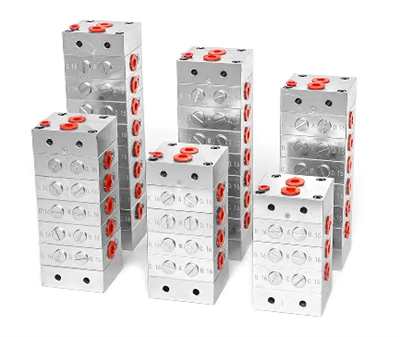
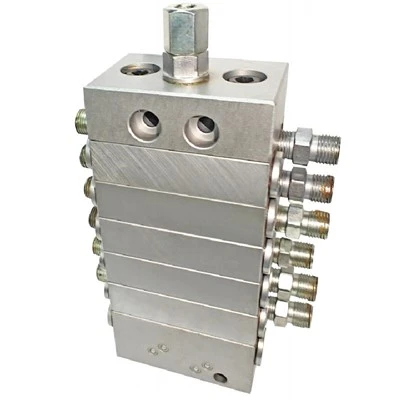
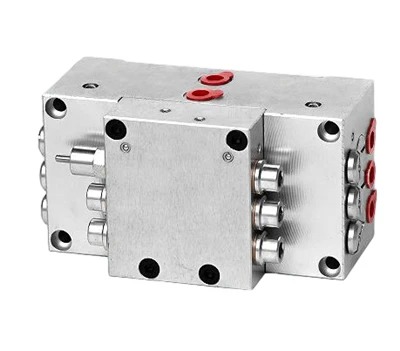
A lubricant divider valve delivers a metered amount of lubricant to each lubrication point through the sequential movement of pistons or plungers, achieving precise and continuous mechanical lubrication.
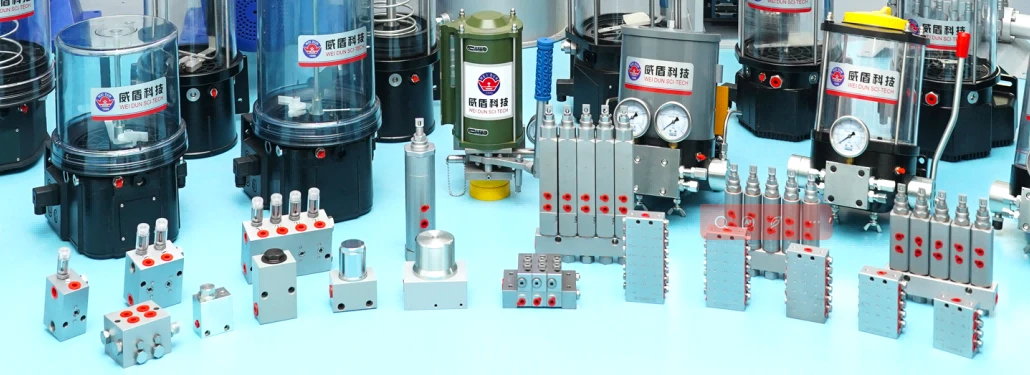
The basic components of the lubricant divider valve:
The power unit (pump station) consists of key components such as motor, pump, and reservoir. It is the power source for the entire lubrication system, responsible for generating continuous and stable high pressure and delivering lubricant to the system, ensuring a continuous supply of fluid power.
The distribution unit (distributor) acts as the central hub for lubricant flow distribution, precisely and quantitatively distributing the lubricant from the power unit to each friction point requiring lubrication, according to the equipment's lubrication needs.
The delivery unit (pipeline accessories) is a fluid delivery network consisting of high-pressure main pipelines, branch pipelines, joints, and various valves, which constructs an efficient and sealed physical transmission channel for lubricant from the pump station to each lubrication point.
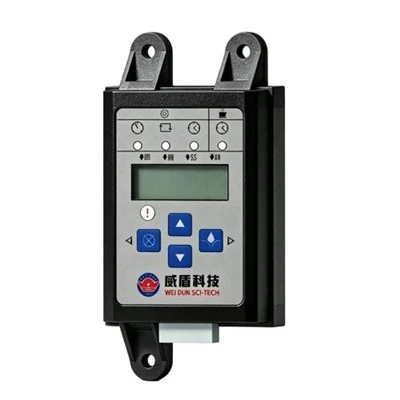
The control and monitoring unit consists of an intelligent controller, pressure sensor, and level sensor, and is responsible for accurately controlling the lubrication cycle, monitoring system pressure and lubricant levels, and ensuring safe and automatic system operation.

Progressive Lubricant Distributor Principle: A progressive distributor is a commonly used core component in industrial lubrication systems. Its structure typically consists of a starting plate, an ending plate, and at least three intermediate plates. Each intermediate plate contains a working piston and two oil outlets, symmetrically distributed at the left and right ends.
Dual-line Lubricant Divider Block Principle: It has two main pipelines, and the two pipelines are alternately pressurized and depressurized by a reversing valve to ensure coverage of all lubrication points in the system. It is a core lubrication solution for heavy industrial applications.
Single-line Lubricant Injector Principle: The core logic is the "parallel injection" and "pressure-relief" cycles, which drive lubricant distribution through periodic pressure changes to achieve efficient replenishment of multiple lubrication points.


Lubricant (grease or butter) is pumped into the distributor, enters the piston chamber through an annular groove, and pushes the pistons sequentially, causing the lubricant in the piston chamber to be discharged from the oil outlet.
The working process is as follows:
● The oil pump starts, and pressurized oil enters the main distributor.
● The pistons move sequentially: Pressurized oil pushes a piston to its end point, discharging a metered amount of lubricant from the corresponding oil outlet.
● Circulating oil supply: After the piston reaches its end point, pressurized oil pushes the next piston, sequentially completing the metered oil discharge from each outlet. Continuous Operation: As long as the pump continuously supplies oil, the distributor piston circulates, continuously delivering lubricant to each lubrication point.
● Monitoring and Safety: If an intermediate piston jams, the entire distributor stops working. Piston movement can be monitored via a proximity switch, enabling alarm and maintenance.
Advantages:
● Progressive distributor: Precise oil supply, compact structure, and ease of monitoring. It is suitable for small and medium-sized machinery and multi-point lubrication systems, delivering a fixed amount of lubricant to up to 150 lubrication points with a delivery length of up to 15 meters.
● Dual-line distributor: Extremely high reliability and system redundancy; powerful high-pressure transmission capability; adaptable to large-scale, long-distance lubrication; lubrication flow rate is independently adjustable.
● Single-line distributor: Simple structure and low cost; a single point of failure does not affect the overall system; installation and maintenance are simple and flexible; synchronous oil supply is highly efficient.
● Applications and Maintenance: Mining machinery, metallurgical machinery, construction machinery, forging and casting equipment. Their features include accurate lubrication cycles, grease savings, increased equipment lifespan, and ease of installation and maintenance. In actual operation, when the pump stops, the piston remains in its current position, and resumes operation from the stopped position for the next oil supply, ensuring continuous and reliable lubrication.