

In the field of industrial lubrication and machinery maintenance, lubricating oil and grease are two commonly used lubricants. While both aim to reduce friction and protect mechanical parts, they differ significantly in composition, physical properties, and applicable scenarios. Correctly distinguishing between them helps in selecting appropriate lubrication products and extending equipment service life.
In terms of form and composition, lubricating oil is a liquid, mainly composed of base oil and additives, and has high fluidity; lubricating grease is a semi-solid, made from a mixture of base oil, additives, and thickeners (such as lithium-based, calcium-based, and polyurea-based), and has low fluidity, appearing as a paste or grease. The main differences in characteristics are: lubricating oil has good fluidity, superior heat dissipation and cleaning properties, and can achieve circulating lubrication; lubricating grease has strong sealing properties, high adhesion, is not easily lost, and has more prominent rust and corrosion prevention effects, but its heat dissipation is poor.


1.Ingredient Structure
Lubricating oil is based on a core of "base oil + additives," with liquid base oil accounting for over 90%; Lubricating grease is a semi-solid system of "base oil + thickener + additives," and their formulation is more complex: the base oil content is approximately 70-90%. Additives enhance functions such as anti-wear and anti-corrosion.
2.Physical Condition
Lubricating oil is a Newtonian fluid with excellent fluidity, providing forced lubrication and heat dissipation, but it has poor sealing properties and is prone to leakage. Lubricating grease is a non-Newtonian fluid with strong adhesion, capable of forming a stable oil film in complex environments, but it has weak heat dissipation and softens easily at high temperatures.
This difference in physical properties directly leads to their different application characteristics. Lubricating oil has excellent fluidity, allowing it to quickly penetrate friction surfaces, while the high adhesion of grease enables it to maintain long-term lubrication on vertical surfaces or in open structures.
3.Performance
Lubricating oil has good fluidity and heat dissipation properties, quickly carrying away heat generated by friction and reducing the temperature after friction. Its sealing performance is relatively poor, but it has good cleaning properties, removing impurities from the friction surfaces.
Lubricating grease has a higher viscosity and good adhesion and sealing properties. It forms a strong oil film on the friction surface, is not easily lost, and can maintain good lubrication on vertical surfaces or in areas subject to impact loads. However, its heat dissipation performance is not as good as lubricating oil, and it is prone to softening and leakage at high temperatures.
4.Three Core Principles for Equipment Selection
Prioritize operating conditions
Equipment compatibility
Cost balance
5.Filling Methods and Application Scenarios
Lubricating oil is typically added using devices such as oil pumps, grease guns, or grease cups. It is suitable for high-speed, light-load mechanical moving parts, such as crankshafts and camshafts in automobile engines, as well as various systems requiring circulating lubrication, such as industrial gearboxes and hydraulic systems.
Lubricating grease could be added manually, via a grease gun, or through a centralized lubrication system. It can be used in low-speed, heavy-load, high-temperature, or dusty working environments, such as automotive wheel bearings, gearboxes in mining machinery, and bearings in power tools. Furthermore, grease is widely used in parts that are not frequently lubricated, such as sealed bearings and outdoor equipment that operates for extended periods.
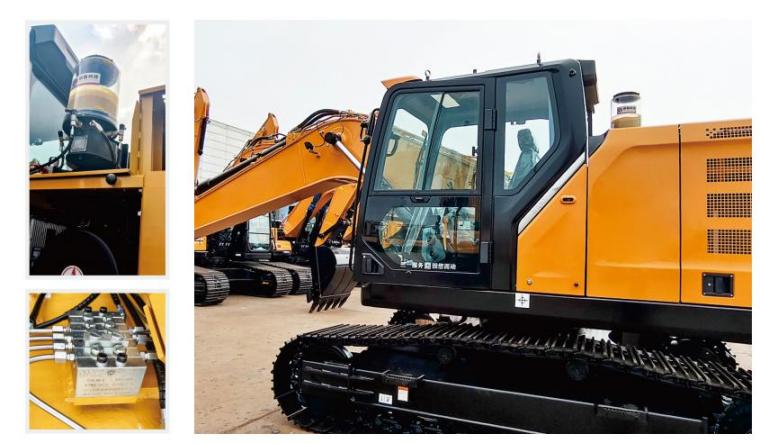
WEIDUN has been dedicated to the research and manufacture of automatic grease system for 27 years. Its professional grease lubrication systems have solved problems such as low manual lubrication efficiency, uneven lubrication points, and inadequate lubrication for numerous equipment manufacturers of all sizes.
WEIDUN's Progressive Lubrication System adopts a plunger pump structure to pumping grease, realize quantitative, timed and fixed-point lubrication. It is suitable for unified lubrication of multiple lubrication points.

The system is equipped with a progressive distributor and other lubrication system parts with the following advantages,
• Extremely high metering accuracy (±5%)
• High system pressure
• Easy to service replacement dispensers
• Easy to determine the point of failure
• Precise grease filling
• Outstanding fault monitoring
• Good scalability
• Highly cost effective
If your equipment has extremely high requirements for precision and reliability, you can choose the WEIDUN progressive lubrication system and its various lubrication system parts. By monitoring only the last point, you can ensure that all the intermediate lubrication points have completed their tasks.
Choose Automatic Grease System, Choose WEIDUN!
Key words: Automatic Grease System
Grease Lubrication System
Lubrication System Parts


